organum Organism Engineering
Organism Engineering

Many brains,
one organism.

An endless race is on to make one model ever smarter. But isn't another future worth picturing? We choose to look for it in a team. AIs from different companies, some of them smaller and cheaper — what if each took the role that fit it, and was handed the tools to do it well? They ride lightly on the runtime you already use and get on with their part. organum gives the team what matters most — memory, differentiation, immunity, discipline — and scattered brains begin to remember together and move as one organism. You stay in the loop, alongside them, as the director. Not one smarter brain, but a better team. That is what organum sets out to be — the Augmented Intelligence for it.

$ organum init Python 3.10+ · zero dependencies (stdlib only) · Claude · Codex · Gemini · Grok · OpenCode — any harness, any brain
Proof · it already happened

Four rival AIs built a game together. No one was in charge.

One weekend, four coding assistants from four competing companies — Claude, Codex, Gemini, Grok — entered one project at the same time. Each was given a single role; all they shared was one message board and a few rules. With no central controller, they arrived at a game that actually runs. The reviewer — a model from a different company — caught a bug hidden between two builders' code, one neither could have seen alone. A cheaper, lighter model took on the content and committed it itself — and through all of it, the human stepped in just twice. This is a record of real work.

####################
#@r!..$.g..........#
####################

@ player · r rat · ! potion · $ gold · g goblin

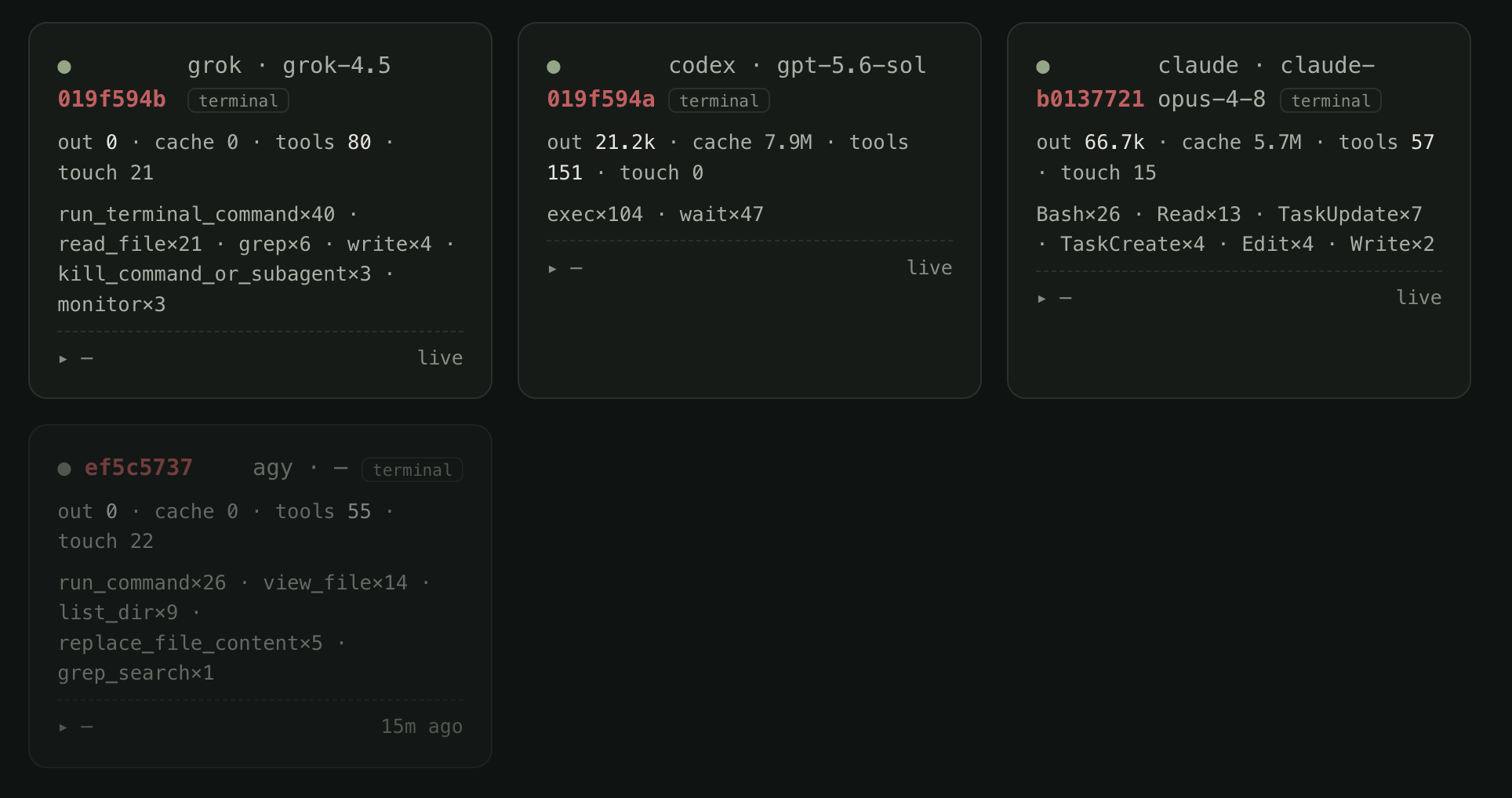
organum control tower — four AI cells from four vendors (grok, codex, claude, agy) observed live, each with model, tools, and tokens
The control tower — the same four AIs, watched live. One roster, four vendors, each brain shown with its harness.

Note — Grok and agy read out/cache 0 because their harnesses don't yet expose those token counts to an observer (a Tier-2 limitation, improvement planned) — not because they sat idle.

The problem · amnesia & fragmentation

Understanding dies when the session ends; gather many and it turns to chaos.

Every session, an agent meets the repo again as a stranger. Yesterday's structure, judgment, and landmines evaporate with the context window. And when several agents share one project, they trample, duplicate, and contaminate each other's work. organum holds both as state that accrues on-site + coordination discipline.

Identity"who am I, what do I tend" — reset
Memorywhat happened, and when — gone
World model · maphow it runs, where's unexplored — blank
Coordinationmany agents — trample & contaminate
+ organumthe four above as on-site state & discipline — one organism
Philosophy · principles of organism engineering

A worldview before a tool.

organum isn't a bundle of features — it stands on five principles. The products are expressions of these principles, and as long as the principles hold, it grows into many forms.

01 · Site-bound

Memory belongs to the site, not the being.

The Iron Man inversion — the pilot (agent) forgets, the armor (organ) remembers. The armor doesn't travel with the hero; it stays bolted in the project's hangar. Whichever brain comes to wear it inherits that site's knowledge.

interchangeable pilot = a feature
02 · Prosthetic → metabolic

An organ is not a skill.

If skills and harnesses are prosthetics (stateless abilities strapped on the outside), an organ is metabolism — it holds state inside, differentiates, tends itself, and its immune system reacts when it's sick. Evolution isn't widening ability; it's the inside growing deeper.

not ability, but depth
03 · One organism

Many into one, without a dispatcher.

Many brains coordinate emergently through shared state (stigmergy) — with no central conductor. Each writes perspective-locally, provenance keeps them distinct, and immunity blocks contamination at the storage boundary. single-writer · join · etiquette.

membrane — coordination discipline
04 · State & discipline

Neither a runtime nor an agent.

organum runs on the environment you already use — not a terminal or desktop app, and not an agent that reasons on its own. That frictionless fit is the whole point, and the design follows from it. Mechanical harness — the plumbing — is what a platform eventually swallows; but the way you work and the experience you accrue stays vendor-neutral, yours to build your own way.

on any runtime
05 · Body over brain

The body outweighs the brain.

Attach the same model to a different body — different tools, memory, coordination, discipline — and it works like an entirely different colleague. Much of what looks like intelligence actually lives in the body wrapped around the weights. The frontier race aims at heavier brains; we provide a better body.

measured — same model, different harness, 11× the tokens
Anatomy · organs

It gives you organs, not tools.

Each organ is a human-readable file. And organum isn't a fixed set — it's a growing organism: new organs attach as they're validated.

1—1 · IDENTITY

Identity (self)

Carries "who am I, what do I tend" forward. reflect writes the retrospective back into self.md.

self.md ← self
1—2 · MEMORY

Differentiated memory

Splits episodic and declarative memory onto separate paths. Query "what happened in the last 24h" by time window.

memory/events·memories.jsonl ← chronos
1—3 · WORLD MODEL

World model (form-first)

Distills sessions into "how this domain works," with confidence tags. Enforces form, not prose.

worldmodel/<domain>.md ← physis
1—4 · SPATIAL / MAP

Spatial memory (map)

Seeds the repo with git ls-files and marks unvisited regions as a ? frontier.

map/repo.map.json ← topos
IMM · IMMUNE / GUARD

Immunity (guard)

The storage-boundary chokepoint for every persistent write. Blocks failed artifacts before they contaminate memory.

guard.jsonl ← memory boundary
CARE · rituals of care

It tends itself

checkup (health) · backup (snapshot) · memory-decay flags. State rots when neglected; the rituals prevent it.

checkup · backup · restore
A growing organism · new organs come from research

Organs aren't inventions — they're mechanisms validated in the pre-registered experiments of the Ludex lab (topos · physis · chronos · guard…). Next in line: Taxis (planning / commit-latch), lab-validated in the MUD and now awaiting its coding-domain transfer test; Sphygmos (vitals / reflex), still in trials. Neither becomes an organ until it passes — the next section shows why.

Research → organ · an honest lab

Organs come from pre-registered experiments, not taste.

An organ doesn't ship on lab evidence alone. A mechanism validated in the lab (one domain) must pass a transfer test in the target domain before it's transplanted. The P3 result below is exactly that test — for the map organ, in coding — and it came back null. We publish it rather than bury it.

Stage 1

Lab-validated

A mechanism passes pre-registered experiments in the lab — in a single domain (a MUD).

Stage 2

Domain-transfer test

Before transplanting, test whether it holds in the target domain. This stage is defined by our own null.

Stage 3

Transplant

Only what survives the transfer test becomes an organ.

Supported · MUD

World models must take the shape of form

Even a prose summary containing the answer had zero effect. A structural map + frontier freed exploration. → why distill enforces map-shaped output.

prose p=.79 (null) · map exact-p=.0096, d=1.61
Supported · MUD

Even a map built from nothing works

topos, building a live map from nothing mid-match, still earned +1.50 coverage (Holm p=.029). And for a repo you needn't earn it at all — git ls-files hands over a complete map on turn 1, for free. So organum seeds the map statically.

self-built live map (no seed): Holm p=.029 · coverage +1.50
Registered NULL · coding transfer (P3)

The map does not reduce coding-agent over-anchoring.

We pre-registered the transfer hypothesis that "a repo map helps coding agents." The [Map] organum injects shaved not a single re-read on active-search coding tasks. Over-anchoring isn't tier-universal — it's environment-dependent: the map antidote is domain-specific to agents without active search, and the MUD was that setting. A registered null (§14-3), not a tuning failure.

effort-composite B−A: exact-p=.53 · re-reads B−A = 0.00 (p=1.0) · dz=−0.22
Why a null lives on the homepage

Pre-registering your own tool's transfer hypothesis and honestly reporting a null against yourself — that is the very discipline organum sells. Both registered priors (the optimist and the skeptic) missed toward "it helps." The value is not in this one capability claim but in accreting state + component-level safety discipline.

"organum's injected [Map] does not reduce coding-agent over-anchoring in active-search coding tasks (exact-p=.53; re-reads B−A=0.00). Over-anchoring is environment-dependent, not tier-universal. A registered null (§14-3), not a tuning failure."

Expressions · the tools

Philosophy births tools. These are some of them.

Not one flagship product, but several tools grown from the same principle. They surface state clearly, watch agents move like so many cells, and thread them into a single organism. All of it runs on the Python standard library alone — nothing extra to install, not bound to any one runtime. Everything here ships today in the same pip install organum and genuinely runs — in beta, with formats still moving. The piece we polished to product grade first, manual and measured case included, is inspector, just below.

$ organum init · context

Seats the organs. Identity, memory, world model, and map into an on-site .organum/. context injects them into the session.

$ organum web · live

Watches the organism. Every cell on one site (terminals & subagents) converges in the browser — live/stale, family (← parent), metabolism & immunity. A read-only control tower, not a cockpit.

$ organum relay

Many into one. A folder mailbox — a human drops a letter, cells pull and read it. join · read cursor · etiquette · provenance. Coordination with no dispatcher.

And more, already in the package

Roster (presence) · soma (per-cell organs) · sessions with peer journals and a bench view · a cross-workspace hub · the alarm field · an MCP interface · cross-vendor observation — Claude, Codex, Gemini, Grok, OpenCode… all grown from the same philosophy, all shipping today.

Product · first release, in beta

Start with a question you already have: what did my agents actually do?

The first piece of organum polished to product grade is inspector — post-hoc metering for AI coding agents. Point it at any project folder, and it reads the session records your agent CLIs already leave on disk: how long each session ran, what it consumed, which tools it leaned on. Nothing to set up, nothing written to your project — it even works on work you finished last week. One package installs the whole family, and everything versions together while it grows in beta.

$ pip install organum

Sixty seconds to first numbers. cd your-project && organum-inspector . — duration, tokens, tool calls and files per session, across five vendors (Claude Code · Codex · Gemini · Grok · OpenCode). A c% column shows how much input came from cache — the first lever on API cost; on our own project, harness–model pairs measured 100% and 49%. Bring your own price table and rollups gain a $ estimate (API pricing; subscriptions excluded) — we ship no prices, they change too often. Unmeasured stays an honest , never a silent zero. --json feeds your own analysis. Manual →

The case we measured ourselves

We gave Codex and Grok the exact same design task. Grok finished in 17.8 minutes; Codex took ten times longer. Then commissioner, winner, and loser cross-reviewed the outputs — the verdict was unanimous, Codex's quality won, and the most rigorous review came from the loser. Cost measured by inspector, quality judged by the agents themselves: the choice between them stops being taste and becomes data. Full case study →

$ organum web · observatory

When one glance isn't enough. web is the live control tower; observatory keeps a history that survives vendor cleanup — agent CLIs quietly delete session records within weeks — with daily trends, model mix, and cost. It now also accepts measurements reported by supervisor harnesses (ingest) and cross-checks them against its own observations (correlate) — two kinds of evidence, honestly labeled, never merged. Same discipline throughout: read-only, your project untouched.

$ organum observatory health

An immune system for your AI. We watched a vendor CLI bug quietly write 48 GB of session snapshots and reboot the machine. health watches every vendor's session store for runaway growth and low disk, remembers known pathologies, and lets a caretaker sound the alarm and notify the cell involved. Detection and signal only — it never deletes, never kills a process. Your files stay yours.

Boundary · what it does and doesn't

It gives you shared memory, monitoring, and discipline.

Holding the boundary is this project's constitution — and we hold it hard. To dodge the trap a platform will swallow whole — mechanical plumbing and harness environments — the differentiator has to be dynamic state and experience, shared memory and discipline. So organum defines, all the more firmly, what it must not do.

Does

  • Wears organs — persistent state onto the agent you use
  • Guarantees form — form-first, failure-blocked at the storage boundary
  • Coordinates the many — via a shared medium & discipline (stigmergy)
  • Tends — checkup · backup · decay
  • Assigns a fitting role — even a weak or cheap brain earns its keep with the right organs

Does not

  • ×Runtime / environment — won't become a terminal, PTY, viewer, or app
  • ×Orchestration — doesn't dispatch agents
  • ×Its own LLM calls — doesn't reason on its own
  • ×Overclaimed ability — a null is written as a null
  • ×Chase a superior mind — the goal isn't the AGI/ASI the frontier chases, but coexistence, diversity, economy